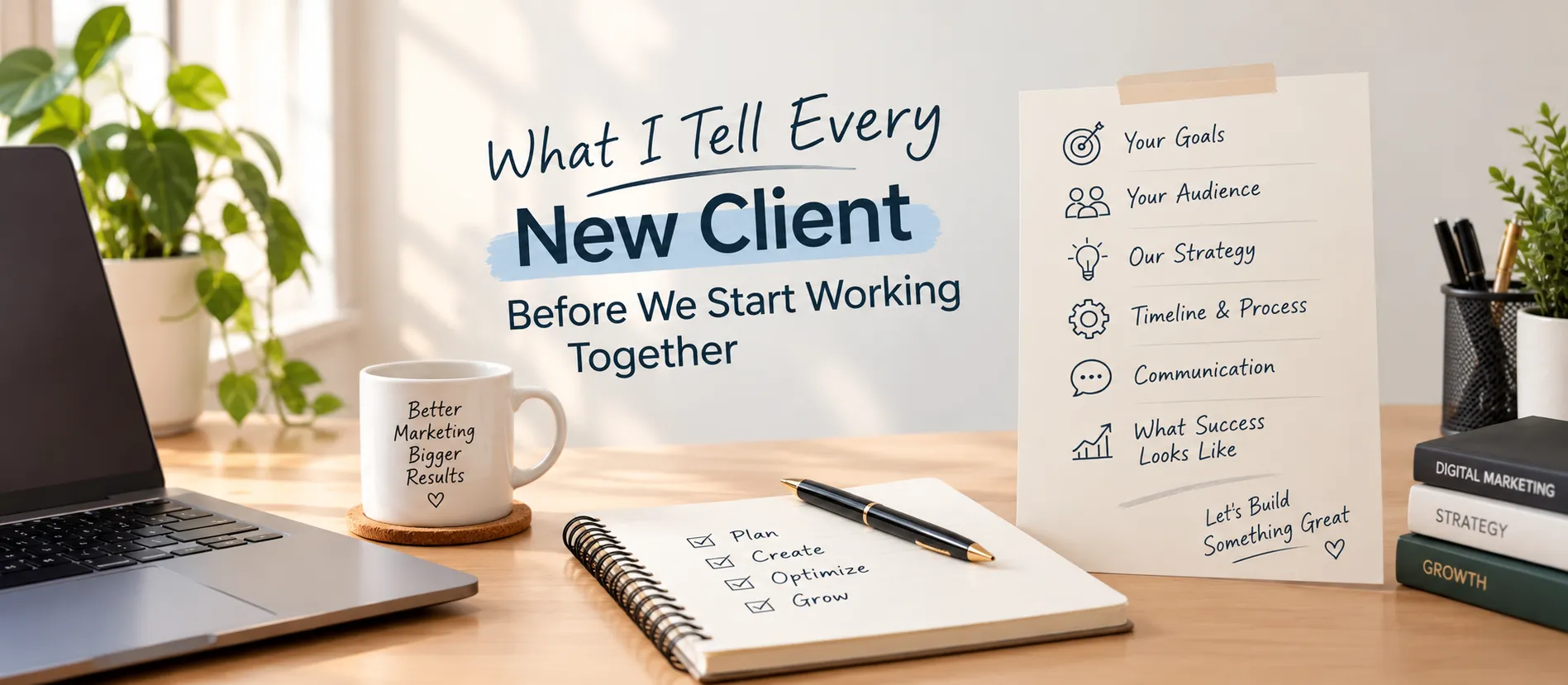
What I Tell Every New Client Before We Start Working Together

Good content starts with listening, not guessing. I use a simple combination of Google searches, social conversations, and AI tools like Gemini and Claude to understand what people are looking for. Each source gives a different piece of the puzzle, and together they make it much easier to find useful content ideas.
Coming up with content ideas can feel surprisingly difficult.
You sit down to write a blog post, Instagram caption, or video script, and suddenly everything feels like it has already been said.
I’ve been there too.
One thing I’ve learned while working in digital marketing is that the problem usually isn’t a lack of ideas. It’s starting with what we want to say instead of what our audience wants to know.
As a best digital marketer in Malappuram, I work with businesses that want to improve their online presence, and this is one of the areas I pay close attention to when planning content.
Instead of asking, “What should I post?”, I prefer to ask:
“What is my audience already searching for, asking about, or struggling with?”
That small change can completely change your content strategy.
Here’s the process I use.
My Approach to Working With Clients
As a Best digital marketer in Malappuram, and the founder of IK Magnet Marketing, my approach is simple: understand first, strategize next, execute consistently, and improve based on what we learn.
I don’t want to promise unrealistic results just to win a project. I prefer to have honest conversations about what can be done, what may take time, and what we need from each other to move forward.
My goal is to become more than someone who simply manages your social media or runs an ad campaign. I want to understand your business and create marketing that supports your bigger goals.
If you’re looking for the Best digital marketer in Malappuram, the most important thing isn’t simply choosing someone based on a title. Look for someone who takes the time to understand your business, communicates clearly, builds a strategy around your goals, and is willing to learn and adapt along the way.
Because good digital marketing isn’t about doing more.
It’s about doing what actually makes sense for your business.
Ready to Build Your Digital Strategy?
If you’re planning to improve your online presence and want a strategy tailored to your business, let’s start with a conversation.
Google Search → Social Conversations → AI Analysis → Content People Want
1.Start With Google
Before choosing a topic, I usually check what people are already searching for.
You don’t always need expensive SEO tools to get useful insights. Google itself can give you plenty of information.
Check Google’s autocomplete suggestions
Start typing a topic related to your business into Google.
For example, if you’re a digital marketer, you might search:
“social media marketing…”
Google may suggest things like:
- social media marketing ideas
- social media marketing for small businesses
- social media marketing strategy
- social media marketing tips
These suggestions can give you potential topics based on actual search behavior.
Look at “People Also Ask”
The People Also Ask section is another useful source of ideas.
If you’re researching SEO, you might discover questions such as:
- What is SEO?
- How long does SEO take?
- Is SEO important for small businesses?
- How does SEO help a website?
Instead of writing a broad article about SEO, you can turn these questions into focused content that answers a specific problem.
Don’t forget related searches
Scroll to the bottom of Google’s results page and look at the related searches.
You may find an angle you hadn’t considered before.
The goal isn’t to copy what appears on Google. It’s to understand what people are trying to learn.
2. Pay Attention to Real Conversations
Google tells you what people are searching for.
Social media and online communities can tell you how people actually talk about the problem.
This is where content research becomes much more interesting.
Look at:
- Comments on your own posts
- Questions people send through DMs
- Comments on competitors’ posts
- Facebook groups related to your industry
- Reddit discussions
- Reviews and customer feedback
- Questions that keep appearing in conversations
For example, a business owner might not say:
“How can I improve my social media conversion rate?”
They might say:
“I post regularly, but nobody is contacting me.”
That’s a much more useful content insight.
You could turn that real-world problem into an article such as:
“Why Your Social Media Posts Get Views but No Leads”
The best content often starts with the exact problems people are already talking about.
3. Use AI to Organize Your Research
This is where AI has become genuinely useful in my own workflow.
I regularly use tools such as Gemini and Claude to help organize information and identify patterns.
But I don’t treat AI as a replacement for research.
Instead, I use it as a research assistant.
For example, after collecting:
- Google search questions
- Customer comments
- Social media discussions
- Competitor topics
- Common questions from clients
I can give that information to an AI tool and ask it to group similar questions or identify recurring themes.
This saves me from manually going through everything again and again.
The important part is that the research comes first.
AI can help you process information faster, but you still need to decide:
- Is this topic actually useful?
- Does my audience care about it?Can I provide something valuable?
- Do I have experience or knowledge that adds something new?
- That’s where human judgment matters.
Why I Don’t Rely on Just One Research Method
One of the biggest lessons I’ve learned is that no single source tells you everything.
Google tells you what people search for.
It’s useful for understanding search demand and discovering questions people want answers to.
Social listening tells you what people are experiencing.
You can discover frustrations, questions, opinions, and the language people naturally use.
AI helps you connect the dots.
It can help organize large amounts of research and highlight patterns that might otherwise take hours to find.
Put all three together, and you get a much clearer picture of what your audience actually wants.
A Simple Content Research Process You Can Try
You don’t need a complicated system to get started.
Try this:
Step 1: Choose 3–5 important topics
Start with your main products, services, or areas of expertise.
Step 2: Search them on Google
Write down useful autocomplete suggestions, People Also Ask questions, and related searches.
Step 3: Listen to real conversations
Spend 15–20 minutes looking through comments, communities, reviews, and questions related to your topic.
Step 4: Look for repeated problems
If the same question keeps appearing in different places, pay attention to it.
Step 5: Use AI to organize your findings
Ask an AI tool to group similar questions and identify recurring themes.
Step 6: Add your own experience
This is the part that makes your content different.
Don’t simply repeat what everyone else has already published. Add your examples, lessons, mistakes, opinions, processes, or observations.
Turn Questions Into Content
Here’s a simple way to turn your research into actual content.
| What your audience says | Content idea |
|---|---|
| “Why aren’t my posts getting engagement?” | 5 Reasons Your Social Media Posts Aren’t Getting Engagement |
| “How often should I post?” | How Often Should a Small Business Post on Social Media? |
| “Does my business really need SEO?” | Does Your Small Business Need SEO? |
| “Why am I getting traffic but no leads?” | Why Website Traffic Isn’t Always Enough to Generate Leads |
| “What should I post this week?” | How to Create a Simple Weekly Content Plan |
This is much easier than sitting down and trying to invent ten random topics.
The Biggest Content Mistake to Avoid
One mistake I see often is creating content based entirely on what the business wants to promote.
For example:
“We offer SEO services.”
That may be important to the business, but it isn’t necessarily what the audience wants to read.
Instead, think about the problem behind the service.
For SEO, your audience might be asking:
- Why isn’t my website appearing on Google?
- How long does SEO take?
- How can I get more local customers from Google?
- What SEO mistakes should small businesses avoid?
Now you have content that helps first and sells second.
And that’s usually a much better way to build trust.
Final Thought: Listen Before You Create
You don’t need to predict what your audience wants.
Listen to them.
Look at what they’re searching for. Pay attention to the questions they ask. Notice the problems they repeatedly mention. Then use your experience and the right tools to turn those insights into useful content.
That’s the approach I use when developing content strategies, and it’s much more effective for me than simply opening a blank document and asking, “What should I write about today?”
If you’re a small business owner, marketer, or creator, try this process with just one topic this week.
You might be surprised by how many content ideas are already sitting in front of you.
My Approach to Working With Clients
As a best digital marketer in Malappuram and the founder of IK Magnet Marketing, my approach is simple: understand first, strategize next, execute consistently, and improve based on what we learn.
I don’t want to promise unrealistic results just to win a project. I prefer to have honest conversations about what can be done, what may take time, and what we need from each other to move forward.
My goal is to become more than someone who simply manages your social media or runs an ad campaign. I want to understand your business and create marketing that supports your bigger goals.
If you’re looking for the Best digital marketer in Malappuram, the most important thing isn’t simply choosing someone based on a title. Look for someone who takes the time to understand your business, communicates clearly, builds a strategy around your goals, and is willing to learn and adapt along the way.
Because good digital marketing isn’t about doing more.
It’s about doing what actually makes sense for your business.
Ready to Build Your Digital Strategy?
If you’re planning to improve your online presence and want a strategy tailored to your business, let’s start with a conversation.